
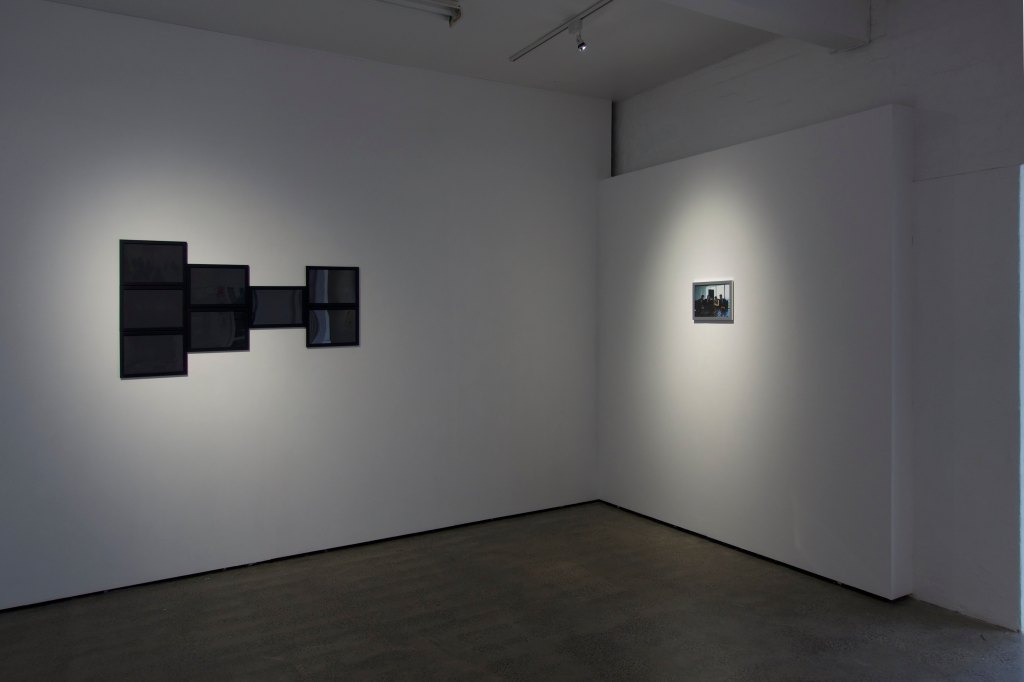
End to End, 2023
In traditional understandings of the teacher/student role, a strict hierarchy separates the former from the latter. Pedagogy is a one-way relation imposed from above, as knowledge is passed hierarchically downwards. Of course, this description sounds positively antediluvian today. For years, pedagogical theorists have stressed the relationship of teacher to student as a shared experience from which both can derive equally valuable insights. Naturally, excessive emphasis on horizontality can also be used as an excuse for translating the acquisition of knowledge into user-pays clientelism. From this utilitarian perspective, the value of distinct knowledge gained through experience over many years is regarded as comparable to the ‘personal opinions’ of those without any prior knowledge or training. One always has to be wary of this kind of overstatement in a world clearly not structured on principles of equality or fairness. That is to say, constant protestations about the necessary primacy of horizontality, devoid of any aspect of hierarchical relation, arise in an era—our own—dictated by the divisive structures intrinsic to contemporary financialized capitalism. They therefore often need to be taken with a grain of salt.
Nonetheless, it is true that relations between teachers and students beyond a certain point—and particularly at a postgraduate level—become instances of contemporaries working within a common milieu. Indeed, preconceptions or the teacher/student divide become intrusive when this becomes the primary focus while viewing an exhibition, for example. In this scenario, the real focus should be, as with any curated exhibition, on how different works speak to one another dialogically and organically: the work takes precedence over institutional structures aimed at containing what can, or cannot, be said. At best, the institution facilitates the development and emergence of free critical thought, which at the same time presents a threat to structures projected ‘rationally as forever instrumentally accountable. Given this, End-to-End is not in any way about the role of institutional pedagogy. If anything, the exhibition is about the questions and experiences elicited by the works themselves—acting within the institution, but more importantly, outside it and within the wider world.
The exhibition’s title suggests multiple parallel readings: the close cultural connections between Australia and Aotearoa (NZ); the Antipodean myth—both countries sharing the notion of being joint ‘ends-of-the-earth’; the role of communication—two tin cups separated by a piece of string, a primitive telephone; end-to-end encryption, the idea of privacy today, constantly under threat; notions of endings—whether the end of capitalism or the end of the world, the latter possibly resulting from climate change or decades of exulting profit over life. Artists within this exhibition address such epochal concepts obliquely—humorously, barely, or not at all.
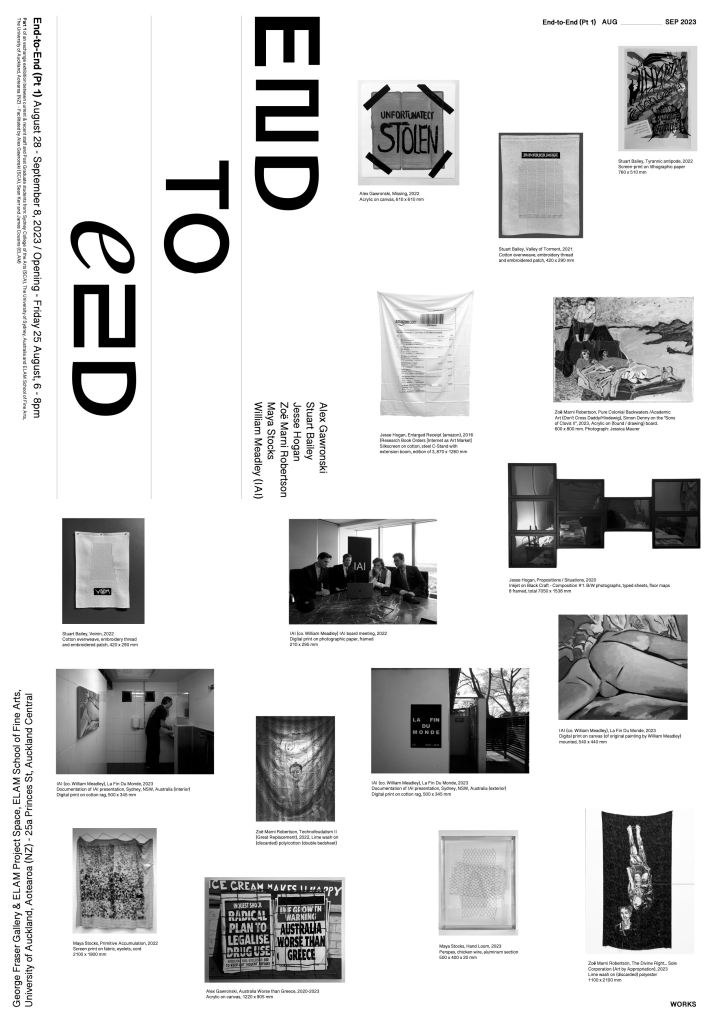
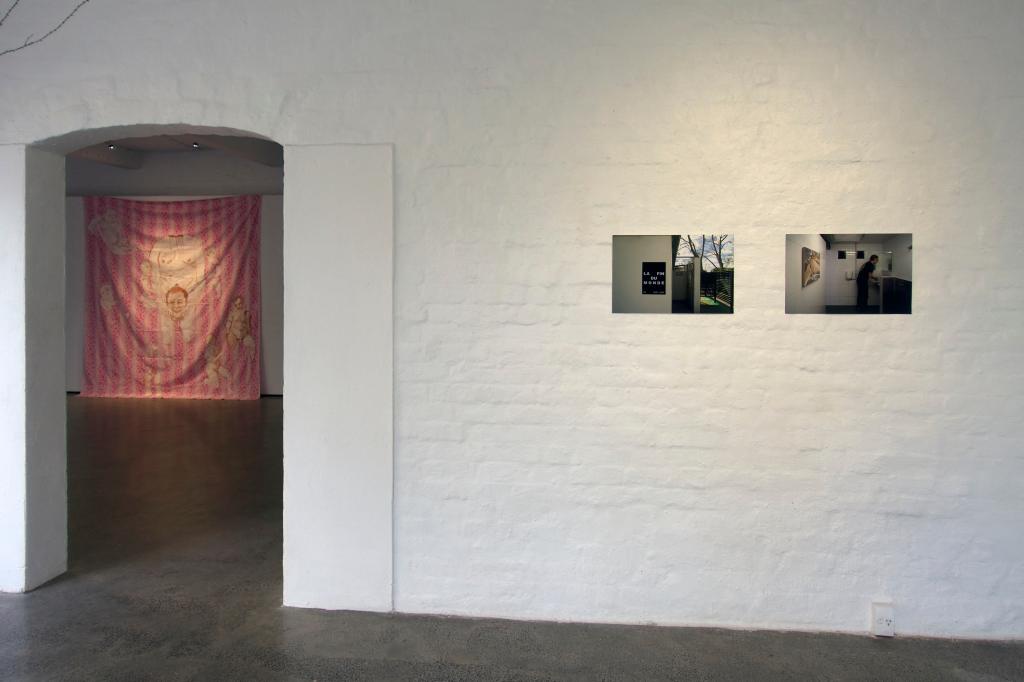
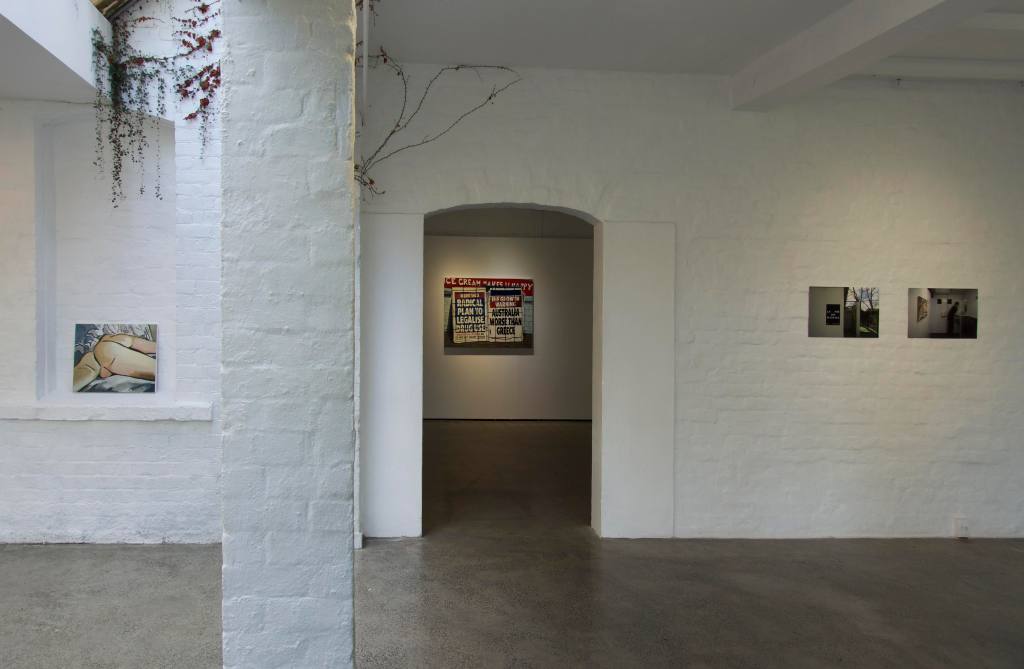
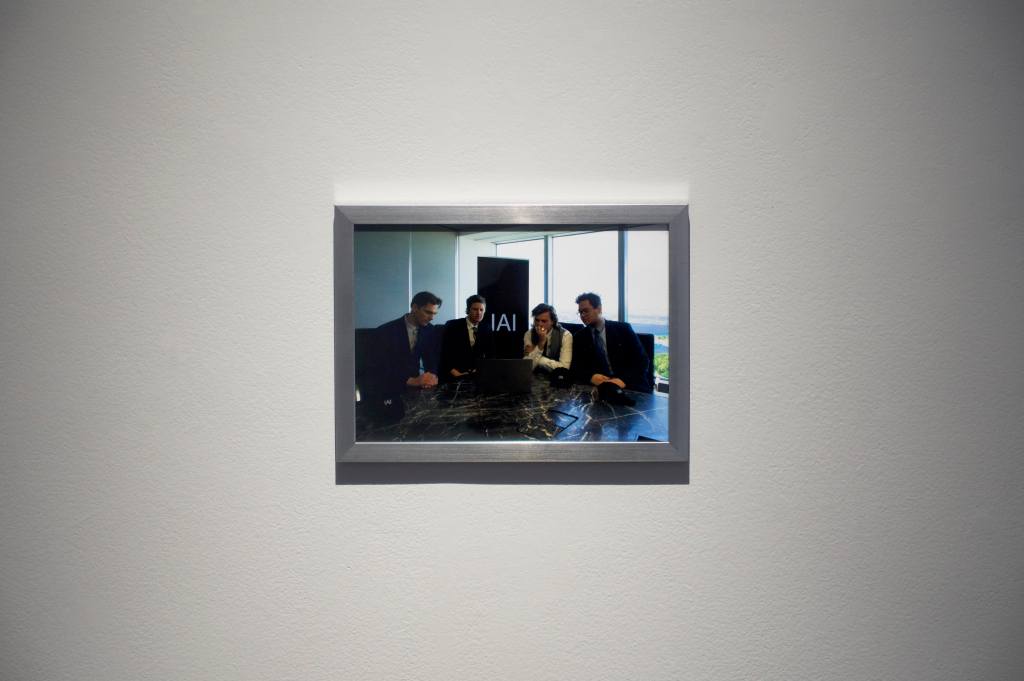
The IAI’s contribution to this exhibition also takes as its starting point a 19th-century French painting. The IAI is a new institutional initiative whose primary spokesperson is William Meadley, an artist and recent master’s graduate from Sydney College of the Arts (SCA). The IAI consists of a members’ board (a meeting of some of its core members appears in this exhibition) and is broadly concerned with opening new art institutional opportunities within—and beyond—Sydney’s urban metropolis. As part of its guiding manifesto, the IAI considers any existing location—external or internal, public or private—a potential site for the establishment of exhibition opportunities and other contemporary cultural presentations. Its freewheeling methodology is evident in the documentation of one of the IAI’s recent manifestations, viewable in this show.
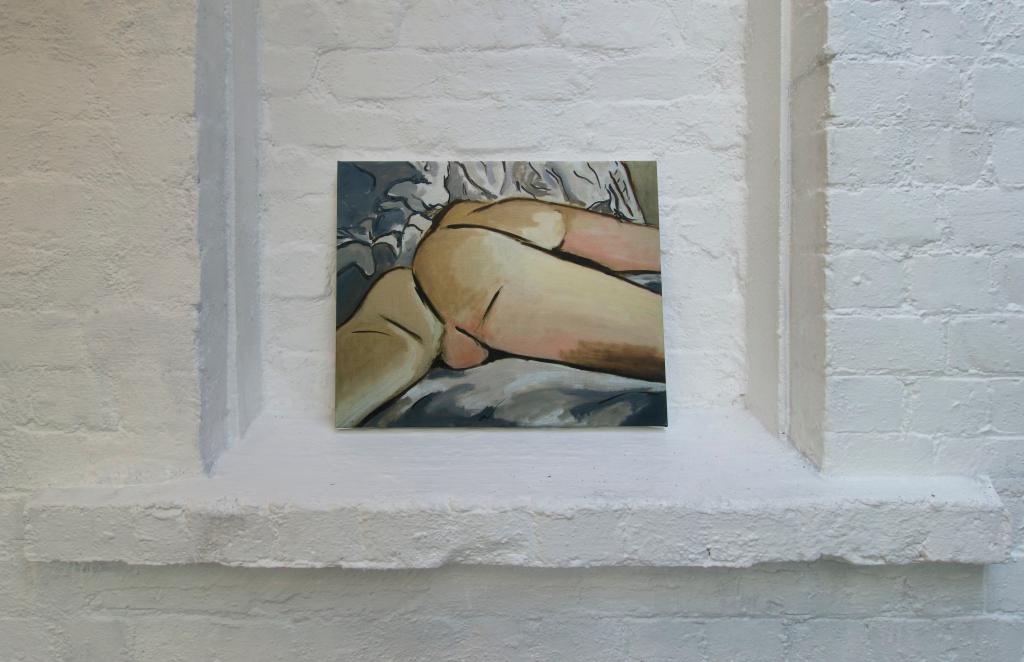
Le Fin Du Monde, a punning reference to Gustave Courbet’s famous L’Origine du Monde, realistically representing the literal origins of all human life, also references a recent self-portrait painting by Meadley. Depicting the artist lying naked, face down on a bed, the work’s title translates directly as the “end of the world”—a conceptual and anatomical reversal of Courbet’s original. The IAI exhibited this painting in 2021 as part of its temporary transformation of a waterside public toilet in Sydney’s Eastern Suburbs into a publicly accessible cultural space. Installed in this environment, Le Fin Du Monde suggested local cultures of gay cruising while raising awareness of the significant differences among contemporary art institutions. With this in mind, the potential for the IAI’s extension into local—and global—cultures is potentially limitless. All locations could serve as raw material for realizing the IAI’s ambitious goals.
While many established art institutions depend on fixed locations and relatively stable demographics, the IAI’s sites and audiences are wildly divergent and ever-expanding. In fact, the IAI could be counted as one of contemporary art’s most inclusive and accessible embodiments of contemporary culture.
– Alex Gawronski

 IAI Institute